
Find Groundwater Before You Drill
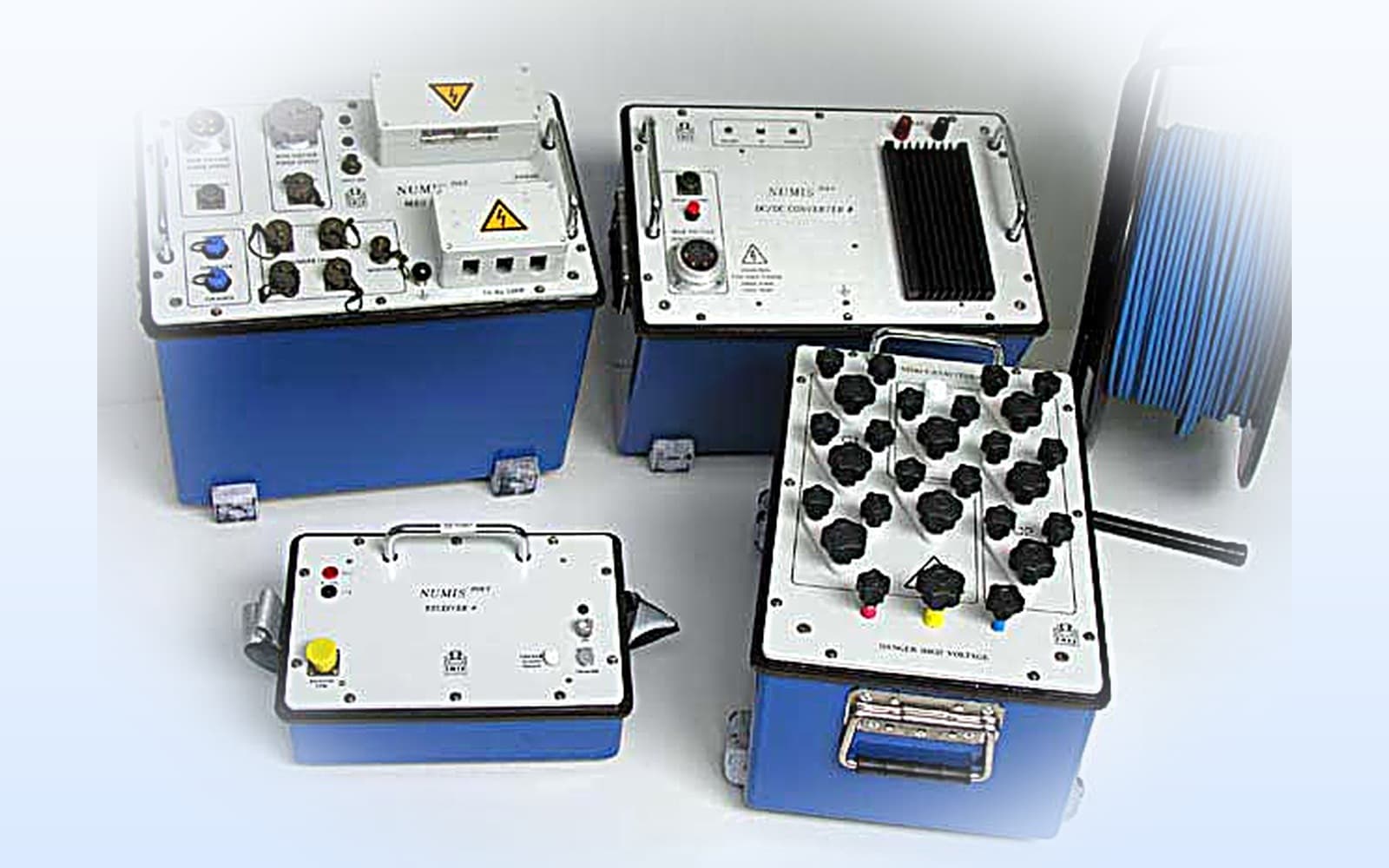
IRIS NUMIS detects groundwater directly using magnetic resonance (NMR) — confirming that water is present and estimating its quantity and depth, so the risk of a dry borehole drops dramatically.
The problem: drilling without certainty is expensive
Ordinary resistivity (geolistrik) only infers water from the soil's electrical resistivity — which could be clay, salt, or minerals, not water. You only learn the truth after drilling. A single dry borehole can cost tens of millions of rupiah, plus wasted time and equipment.
Resistivity infers. NUMIS confirms.
NUMIS uses the same physics as a medical MRI: it responds only to water molecules. If NUMIS reads a signal, there is water there.
| Aspect | Resistivity (Geolistrik) | IRIS NUMIS (NMR) |
|---|---|---|
| How it detects water | Indirect — inferred from resistivity | Direct — from water molecules |
| Result certainty | Ambiguous (could be clay/salt/minerals) | Confirmed water, + estimated quantity & depth |
| Dry-hole risk | High | Far lower |
How NUMIS works
Lay out the loop
A wire loop is laid on the ground surface (typically 50–150 m).
Send a pulse
The instrument sends a pulse at the frequency that makes water protons resonate.
Read the signal
When the pulse stops, water molecules emit a tiny signal that NUMIS measures.
Get the result
The signal is processed into water presence, quantity, and depth information.
What you get
Water — yes or no
Direct confirmation of groundwater, not a guess.
Estimated quantity
Water-content estimate from signal strength.
Depth
Sounding to roughly 150 m (NUMIS Poly).
Productivity indication
A hint of how readily the aquifer yields water.
Who it's for
NUMIS is most valuable where drilling risk is high:
Even stronger: map with resistivity, confirm with NUMIS
Resistivity remains useful for broad, economical initial mapping. Pair it with NUMIS to confirm water before drilling — a complete groundwater-exploration package from a single vendor.
NUMIS Lite sand dune test in France
IRIS documentation presents a NUMIS Lite test on a sand dune in southwestern France. Two measurement stations show signal curves and porosity profiles with depth to investigate groundwater layers. This example was published by the manufacturer. Loop configuration, electrical noise, and geology should be considered when planning measurements at your site.
View the field test in the IRIS NUMIS Lite document (PDF, page 2) ↗Why Jatific
Request a Consultation or Demo Survey
Tell us your location and water needs — our technical team will get back to you.
Learn more
Frequently Asked Questions
- Is NUMIS more expensive than resistivity?
- Yes, the upfront investment is higher. But NUMIS confirms water before you drill — a single avoided dry borehole often already covers the survey cost. For high-value projects, that certainty pays off.
- To what depth can NUMIS detect water?
- NUMIS Lite to roughly 50 m, and NUMIS Poly to roughly 150 m, depending on geology and the level of electromagnetic noise at the site.
- Where is NUMIS less suitable?
- NUMIS needs a relatively open area to lay out the loop and is sensitive to electromagnetic noise (e.g. near high-voltage power lines). In very noisy or cramped sites, results can be degraded.
- How long does one NUMIS survey take?
- A single sounding point typically takes a few hours, depending on target depth and noise conditions. Our team can help plan your survey.
- Is NUMIS the only NMR instrument in Indonesia?
- As far as we know, NUMIS is the only surface-NMR instrument with an authorized distributor in Indonesia. Jatific provides the unit, technical support, and training.