
Meet SNI 1726 with Accurate Vs30 Profiles
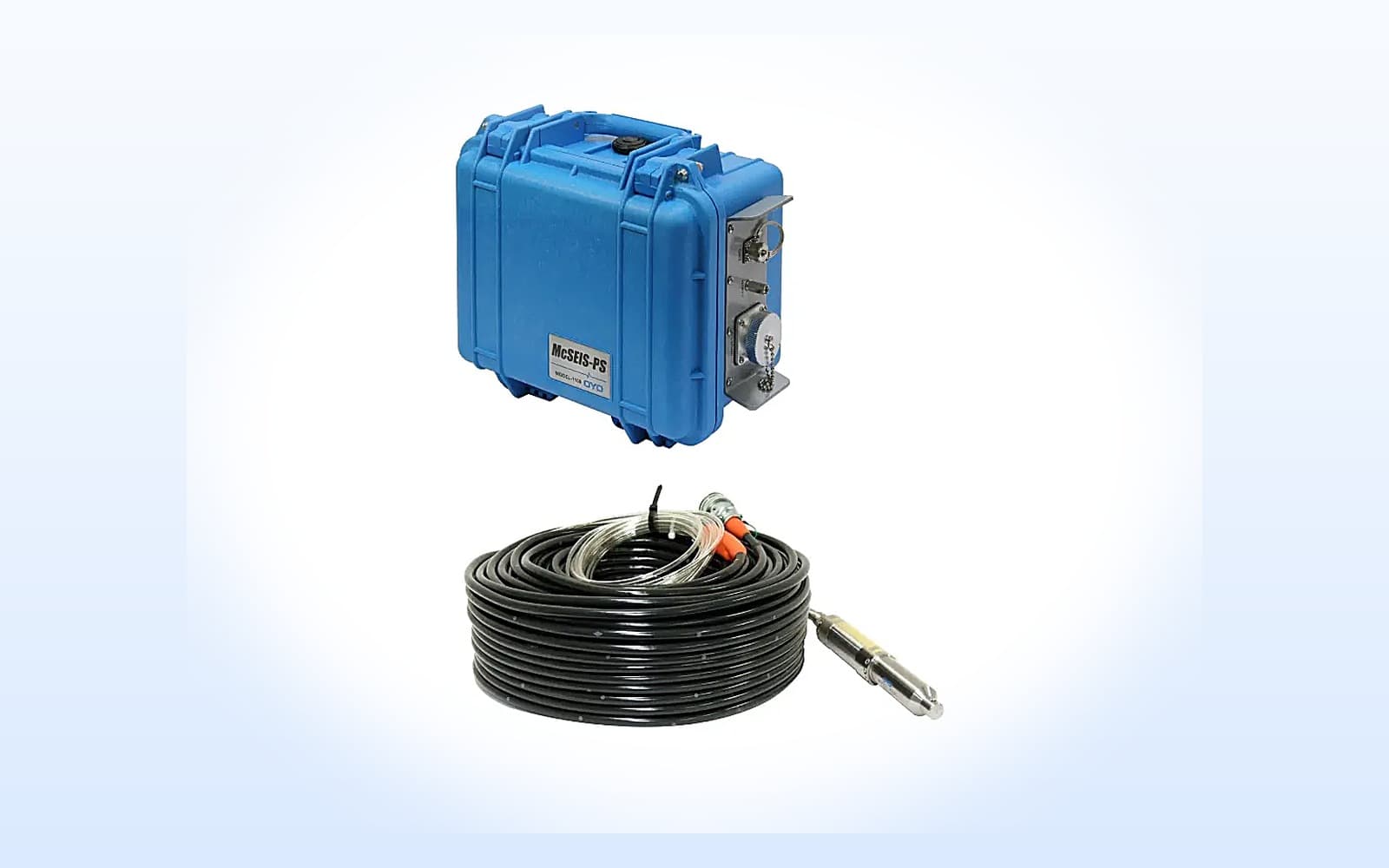
OYO McSEIS-PS suspension PS logging measures shear-wave velocity (Vs) directly inside the borehole — delivering accurate, defensible Vs30 profiles and seismic site class for buildings, bridges, and dams.
The problem: weak Vs30 makes your seismic design questionable
SNI 1726 requires seismic site classification based on Vs30 (the average shear-wave velocity of the top 30 m). Surface methods like MASW are fast and cheap, but their resolution degrades in deep, soft, or layered ground — so the resulting site class can be ambiguous and hard to defend in review.
MASW screens. PS logging confirms.
Suspension PS logging measures Vs directly inside the borehole at every depth — not inferred from the surface. The result is the most accurate Vs profile, especially in deep, soft sites. OYO invented and sets the world standard for this method.
| Aspect | Surface MASW | Suspension PS Logging (OYO) |
|---|---|---|
| How Vs is measured | Indirect — from the surface | Direct — inside the borehole |
| Accuracy in deep/soft ground | Degrades | High & consistent |
| Defensibility for SNI 1726 | Can be ambiguous | Strong per-depth Vs data |
How suspension PS logging works
Lower the probe
The probe is lowered into the borehole (as small as 56 mm).
Generate waves
A source on the probe generates P- and S-waves in the borehole wall.
Record per depth
A 3-component geophone records travel times at each depth interval.
Compute Vs & Vs30
Data is processed into Vs/Vp profiles, the Vs30 value, and site class.
What you get
Vs & Vp profiles
Shear- and compressional-wave velocity per depth.
Vs30 value
Average Vs of the top 30 m for site classification.
Site class (SC)
Seismic site class determination per SNI 1726.
Defensible report
Strong per-depth data for design review.
Who it's for
Suspension PS logging matters to anyone designing in a seismic zone:
Complete it: screen with MASW, confirm with PS logging
Surface MASW (Geode/McSEIS seismographs) is great for fast, broad initial mapping. Pair it with suspension PS logging for the most accurate Vs30 in the borehole — a complete site-characterization package from a single vendor.
Field proof
We're preparing an Indonesian suspension PS logging case study — Vs30 profiling for an infrastructure project and its site-class determination. Want your project to be the first case study? Contact us for a logging demo.
Why Jatific
Request a Consultation or Logging Demo
Tell us about your project and Vs30 needs — our technical team will get back to you.
Learn more
Frequently Asked Questions
- What is Vs30 and why is it required?
- Vs30 is the average shear-wave velocity of the top 30 m of ground. SNI 1726 uses it to set the seismic site class, which determines the design seismic loads for buildings, bridges, and dams.
- How is PS logging different from MASW?
- MASW measures from the surface and infers Vs (fast and economical, but resolution degrades with depth). Suspension PS logging measures Vs directly inside the borehole per depth — the most accurate, especially in deep and soft ground.
- What kind of borehole is needed?
- McSEIS-PS with the Borehole Pick (Model-3315) works in boreholes as small as 56 mm. Our team can help plan the depth and borehole preparation.
- Can the results be used for SNI 1726?
- Yes. Per-depth Vs profiles and the Vs30 value from PS logging map directly to the SNI 1726 site class, and provide strong data for design review.
- Does Jatific provide training?
- Yes. Jatific provides consultation, demos, operator training (including SeisImager/DH software), and after-sales support across Indonesia.